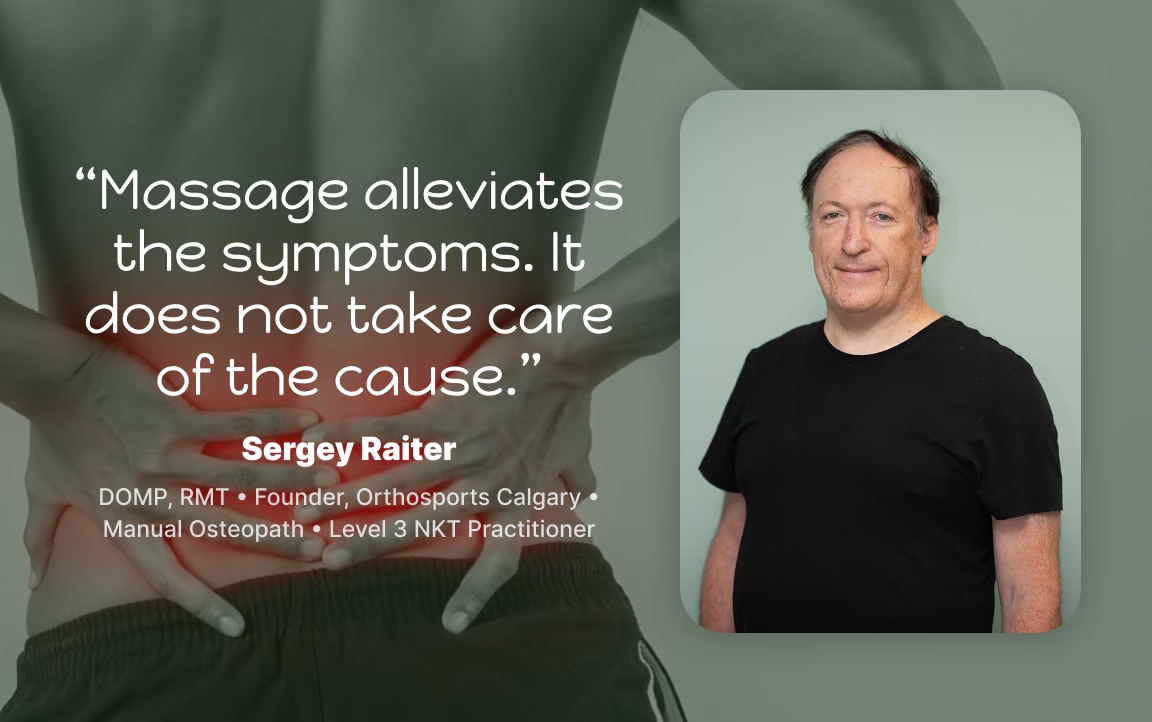

Reviewed by Sergey Raiter, DOMP, RMT, Manual Osteopathic Practitioner and certified Level 3 NeuroKinetic Therapy practitioner at Orthosports Calgary.
Quick answer: If you sit at a desk all day in Calgary and your lower back, hips or neck ache by the afternoon, the cause is usually not the sore spot itself. Hours of sitting switch off the muscles that should support you, so other muscles overwork and tighten. Orthosports Calgary, an orthopedic massage and manual osteopathy clinic in SW Calgary, finds which muscles have stopped working and retrains them with NeuroKinetic Therapy, so relief lasts instead of fading two days after a massage.
Key takeaways
- Desk and office workers in Calgary most often get lower back ache, tight hips, and neck and shoulder tension, a pattern many people call tech neck.
- A relaxation massage can loosen tight muscles for a day or two, but if the underlying pattern is not corrected, the pain comes back.
- Orthosports Calgary starts every visit with an assessment to find the real cause, then treats it with orthopedic massage, deep tissue work and NeuroKinetic Therapy.
- Sergey Raiter is a Manual Osteopathic Practitioner and a Level 3 NeuroKinetic Therapy practitioner, one of the higher NKT certification levels in Calgary.
- The clinic is in Manchester Industrial, across from CF Chinook Centre, with free parking, evening hours, and direct billing to most major insurers.
Ready to stop managing the same ache every week? Book an assessment at Orthosports Calgary or call (403) 984-9962.
Why does sitting all day cause back and neck pain?
When you sit for hours, your hip flexors stay shortened and your glutes, the big muscles that should stabilize your pelvis and lower back, go quiet. Your body still needs to hold you upright, so smaller muscles in the lower back and around the spine pick up work they were never built to do. Over weeks and months, those muscles become tight, tired and sore. That is the deep, nagging ache so many Calgary office workers feel by mid afternoon.
The same thing happens higher up. Leaning toward a screen pulls your head forward, and the muscles at the base of your skull and across your shoulders strain to hold it there. Your head weighs more than you think, and every centimetre it drifts forward adds load. That is the familiar burning tension between the shoulder blades, the stiff neck, and the headaches that build through the day.
The important point, and the thing most treatment misses, is that the muscle that hurts is often not the muscle causing the problem. The ache you feel is usually the muscle that is compensating, working overtime to cover for one that has switched off. That is why rubbing only the sore spot gives short relief at best.

Which muscles switch off, and why does it matter?
In desk workers, the muscles that most often go quiet are the glutes and the deep core stabilizers. When they stop firing, the lower back muscles and the hip flexors take over. You end up with a lower back that is doing a job it was never meant to do, hour after hour, which is why it aches and why stretching alone rarely fixes it. Stretch a tight muscle that is only tight because it is overworking, and it tightens straight back up.
Higher in the body, the deep neck flexors and the muscles that set your shoulder blades can switch off, leaving the upper trapezius and the muscles around the shoulders and upper back to brace all day. This is the pattern behind tech neck. Finding exactly which muscles have gone quiet, for your body, is the whole point of an assessment, and it is what lets us treat the cause rather than chase the symptom.
Why does my back pain keep coming back after a massage?
A standard relaxation massage feels good because it eases the tight, overworked muscles for a little while. But if the muscles that switched off are still switched off, your body goes straight back to the same compensation the moment you sit down again. Within a day or two, the ache returns, and you book another massage, and the cycle repeats.
This is the single most common thing we hear from office workers at Orthosports. Massage treats the symptom. To get a result that lasts, you have to treat the cause, which means finding the muscles that are not pulling their weight and switching them back on. Sergey explains this in plain language in his interview on recurring lower back pain, where he puts it simply: massage alleviates the symptoms, it does not take care of the cause.
What is orthopedic massage, and how is it different?
Orthopedic massage is a results focused approach that assesses and treats the cause of pain in muscles, tendons, ligaments and joints, rather than running a set full body routine. It suits people who have a specific problem to solve, like desk related back pain, rather than those who just want to relax.
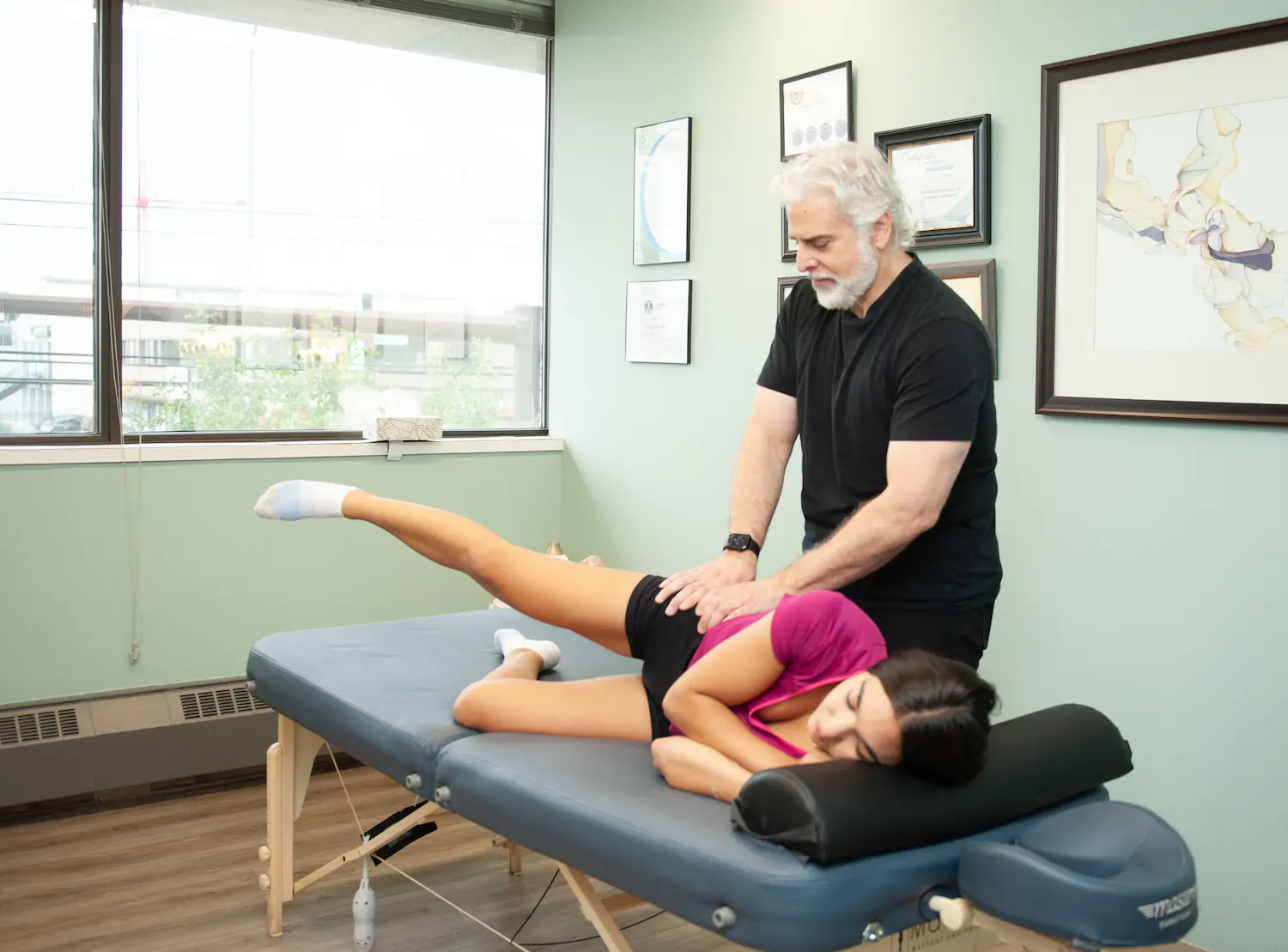
At Orthosports, orthopedic massage combines a full assessment, deep tissue work to release the muscles that have been overloaded, and NeuroKinetic Therapy, a precise muscle testing system that lets us retrain the pattern at the level of the nervous system. For people whose pain is more stubborn or long standing, manual osteopathy adds another layer. The right mix depends on what the assessment finds. If you are weighing whether you need more than a regular massage, our guide to the 5 signs you need to see an osteopath is a good place to start.
How does Orthosports find and treat the real cause?
Every first visit starts with an assessment, not with the table. We ask about your pain, your work setup and your day, then test how you move, your range of motion, and how specific muscles respond when we challenge them. This tells us which muscles have gone quiet and which are overworking to cover for them. If you want to know exactly how a first visit runs, we lay it out in what to expect at your first visit.
From there, treatment is targeted. We retrain the switched off muscles, release the overworked ones, and work the specific area that hurts, whether that is your lower back and hips, your neck or your upper back. You leave with a short set of movements to keep the result between visits. For many desk workers, that is the difference between needing a massage every week and actually moving past the problem.
Not sure what to book? Start with a 30 minute assessment and we will tell you exactly what you need. Book online here.
What can I do at my desk between sessions?
A few habits make a real difference, and they work best alongside treatment that fixes the underlying pattern.
- Stand up and move for a minute or two every half hour, even just to walk to the kitchen. Motion wakes up the muscles that sitting puts to sleep.
- Set your screen so the top is at eye level, so you are not dropping your head forward for hours.
- Keep your feet flat and your hips slightly higher than your knees.
- Switch positions often. The best posture is the next one, not one perfect position held for eight hours.
- Do not cradle a phone between your ear and shoulder.
- Walk for part of your lunch. Even ten minutes resets your hips and spine.
The Canadian Centre for Occupational Health and Safety has a thorough guide to office ergonomics if you want to set your workstation up properly. These habits ease the load, but if your pain keeps returning no matter how good your setup is, the pattern underneath still needs to be corrected, and that is what an assessment is for.
How many sessions will I need?
Many desk workers feel a clear change within the first one to three visits, because once the right muscles are switched back on, the overworked ones stop straining. How long the full plan takes depends on how long the pattern has been there. A problem you have had for a month settles faster than one you have carried for ten years. After your assessment we give you a realistic picture rather than an open ended schedule, because the goal is to get you out of pain and keep you there, not to book you in forever.
Is this covered by insurance in Calgary?
Treatment at Orthosports is provided by registered massage therapists and is receipted as massage therapy. We direct bill Sun Life, Canada Life, Alberta Blue Cross, Medavie Blue Cross and Green Shield, so for many clients there is little or nothing to pay up front. Coverage depends on your plan. You can read the details in our direct billing and insurance guide.
Where can I get help for desk related back pain in Calgary?
Orthosports Calgary is at 205-222 58 Ave SW, in Manchester Industrial, directly across from CF Chinook Centre, with free parking on site. We are open Monday to Friday and Sunday from 10 AM to 9 PM, which makes it easy to come before or after work. Office workers reach us easily from downtown Calgary, Windsor Park, Haysboro, Kingsland, Fairview and the communities around Chinook, and we are minutes from both Macleod Trail and Deerfoot Trail.
Book your assessment now and let us find what is actually causing your pain. Reserve a time online or call (403) 984-9962.
Frequently asked questions
How long before my back feels better?
Many desk workers feel a clear change within the first one to three visits, because once the right muscles are switched back on, the overworked ones stop straining. Your full plan depends on how long the pattern has been there, and we give you a realistic picture after your assessment.
Do I need an assessment every time?
No. The full assessment is most important at the start, so we can find the cause. After that, sessions focus on treating and maintaining the result.
Is this the same as a regular massage?
No. A regular massage works on tight muscles to help you relax. Our approach starts with an assessment and treats the specific cause of your pain, with the goal of a result that lasts rather than a temporary release.
Can posture or a standing desk fix this on its own?
Good habits and a well set up workstation reduce the load and are worth doing, but if certain muscles have already switched off, the compensation pattern usually needs hands on correction before the pain stops returning.
What should I book for my first visit?
If you are not sure, book a 30 minute assessment. We test how you move, explain what we find, and recommend the right treatment from there.
Do you treat neck and shoulder tension too, or only lower backs?
Both. Desk work tends to cause a connected pattern through the lower back, hips, neck and shoulders, and we assess and treat the whole pattern, not just one sore area.
About the author
Sergey Raiter, DOMP, RMT, is a Manual Osteopathic Practitioner and a certified Level 3 NeuroKinetic Therapy practitioner at Orthosports Calgary. He focuses on finding and treating the cause of pain rather than only easing symptoms, so clients can move better and stay out of pain for longer.