
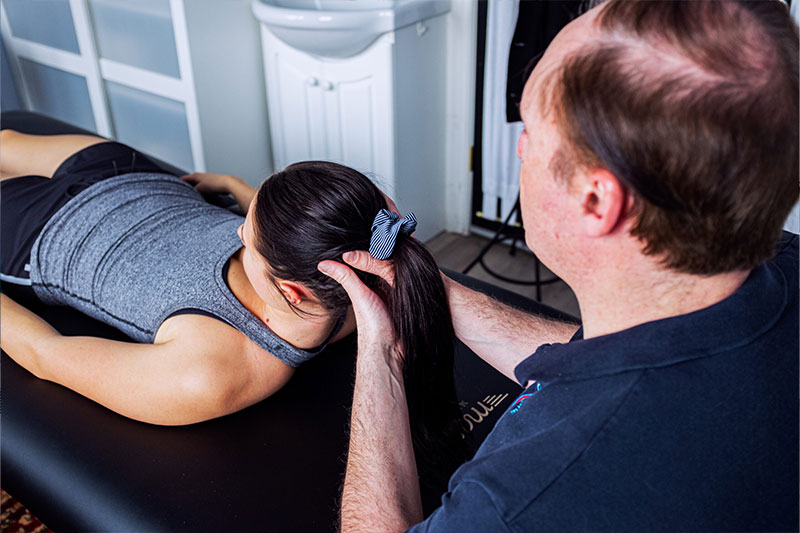
What to Expect at Your First Visit to Orthosports Calgary
Walking into a new clinic for the first time usually carries a small knot of uncertainty — especially if you’re coming in with pain that’s been nagging for months. This post removes the uncertainty. Here’s exactly what your first visit to Orthosports Calgary looks like, from the second you walk in to the moment you leave with a plan.
Before your appointment
We’ll send you a short intake form when you book. Fill it out ahead of time — it saves ten minutes off your first session.
What to bring:
- Your health card and any insurance plan details
- A list of medications or recent treatments
- Any imaging or reports from past injuries (MRI, X-ray, physio notes) if you have them
What to wear: Comfortable, stretchy clothing. Athletic wear is perfect. For manual osteopathy you’ll stay fully clothed — no draping, no oils. For a deep tissue massage, we’ll work clothed or draped depending on your preference. Either way, pick something that lets your joints move freely.
How to find us: 205-222 58 Ave SW, Calgary, AB T2H 2S3 — directly across from CF Chinook Centre in Manchester Industrial. Free on-site parking. Calgary Transit accessible via the Chinook LRT station (7-minute walk).
Plan to arrive 5 minutes early on the first visit so we can finish any remaining paperwork before treatment time.

Step 1 — The assessment
Every first visit at Orthosports starts with an assessment. Not a “chat while you lie face-down on a table” check-in, but a real movement and postural evaluation. This is what makes us different from most clinics, and it’s the reason our clients get results.
Here’s what we look at:
- History. What you do for work, what your activity looks like, how your pain started, what’s made it better or worse, what you’ve already tried.
- Postural analysis. Standing, seated, walking. We photograph or note key asymmetries.
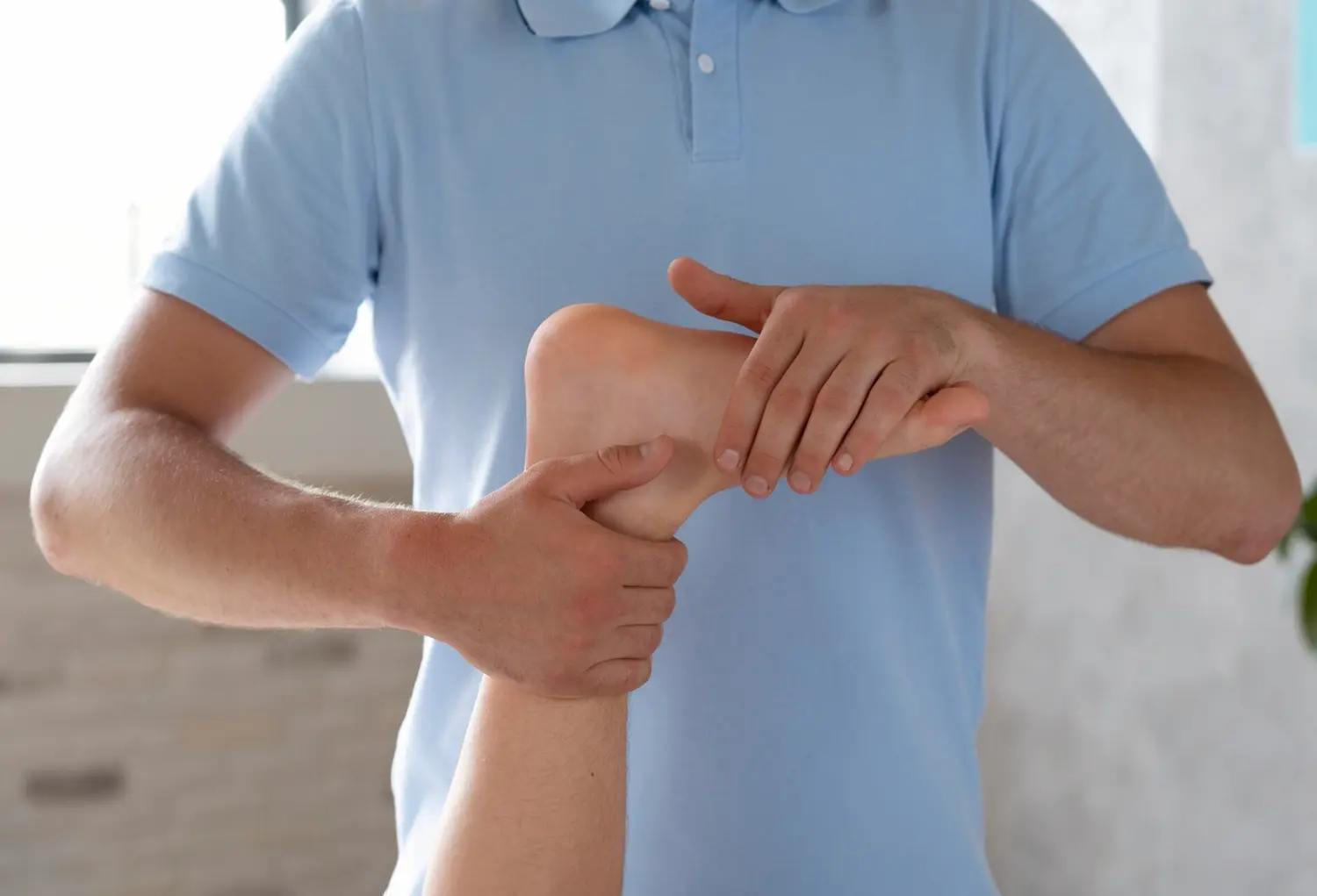
- Active range of motion. How far you can move a joint under your own power.
- Passive range of motion. How far we can move a joint with your muscles relaxed.
- Resistance testing. Loading specific muscles and tendons to find which tissues are contributing to pain.
- Orthopedic special tests. Specific manoeuvres that isolate structures — ligaments, nerves, tendons — and tell us which one is the real source.
By the end of the assessment, we can usually name the exact tissue causing your pain. That’s the whole difference between “generic massage” and “orthopedic therapy.”
Step 2 — Targeted treatment
Once we know what’s wrong, we start treating it. Depending on your presentation, we’ll use some combination of:
- Cyriax transverse friction — direct friction across tendons, ligaments, or scar tissue to break up adhesions and restore glide
- Joint mobilization — restoring normal motion in restricted joints
- Myofascial release — freeing up fascial restrictions that limit movement
- RAPID NeuroFascial Reset — fast, focused fascial release for stubborn areas
- Craniosacral therapy — when the nervous system itself needs calming (post-concussion, migraines, TMJ)
- Acupuncture — where inflammation, hormones, or systemic tension are driving symptoms
Most first-visit treatments run 45–60 minutes of hands-on work, following the assessment. For the 75-minute introductory package (assessment plus NKT), you’ll get both the full evaluation and a first round of targeted treatment in one session.
Step 3 — Your recovery plan
Before you leave, we build a preventive maintenance and home-care plan. This is not a generic stretch sheet. It’s two to four specific movements we picked based on what we found during your assessment — the ones that will make the biggest difference between sessions.
You’ll also get:
- A clear sense of how many sessions you’ll likely need
- Specific guidance on sleep position, desk setup, or training modifications if relevant
- A receipt you can submit to your insurance provider
How many sessions will you need?
Honest answer: it depends on the problem. Acute issues — a fresh neck tweak, a pulled muscle from a weekend hike — often resolve in 1–3 visits. Chronic issues that have been building for years take longer. Typical ranges:
- Acute pain or recent injury: 1–3 sessions
- Chronic tension or repetitive-strain issues: 4–6 sessions
- Complex post-injury rehab or post-concussion recovery: 8–12+ sessions, tapering over time
We’ll give you a realistic estimate after the assessment. Our goal is to get you out of pain and then release you back into life — not to put you on an indefinite maintenance schedule.
Insurance, pricing, and payment
We accept most private extended health benefit plans — Blue Cross, Sun Life, Manulife, Canada Life, and employer-sponsored plans. Payment is due at time of service, and we provide receipts you can submit to your provider. Direct billing availability depends on your plan — ask us when you book.
How to book
You don’t need a referral. Book your first session online or call (403) 984-9962. If you’re not sure which service is the right starting point, the 75-minute Introductory Massage (Assessment + NKT) is usually the best entry point.
FAQ
Do I need a referral to book a manual osteopathy or massage session at Orthosports?
No referral is needed. You can book directly online or by calling (403) 984-9962. Your first session includes a free movement and postural assessment before any hands-on treatment begins, so you’ll always know what you’re dealing with before you commit to a plan.