

Reviewed by Sergey Raiter, DOMP, RMT. Published October 2026.
If you have been searching for microcurrent therapy in Calgary, you have probably run into three sets of letters: TENS, FSM and MPS. All three use electrical current to help with pain, and they are often described as if they were the same thing. They are not.
The short answer
TENS sends a stronger pulsed current through sticky pads to dull pain while the unit is on. Frequency-specific microcurrent (FSM) runs two channels of very low current at paired frequencies and is usually not felt. MPS, or microcurrent point stimulation, applies low-frequency DC microcurrent to precise acupuncture and trigger points with a hand-held Dolphin Neurostim device.
Orthosports Calgary offers MPS. We do not offer FSM or TENS.
Want to try MPS therapy in Calgary?
MPS sessions at Orthosports are with Sergey Raiter, DOMP, RMT, across from Chinook Mall. Direct billing available.
MPS vs FSM vs TENS at a glance
| TENS | FSM | MPS (Dolphin Neurostim) | |
|---|---|---|---|
| Full name | Transcutaneous electrical nerve stimulation | Frequency-specific microcurrent | Microcurrent point stimulation |
| Strength of current | Milliamps | Microamps, about 1/1000 of TENS | Microcurrent, concentrated at one small point |
| Type of current | Pulsed, adjustable frequency | Two channels, each set to its own frequency | Direct current (DC) pulsed at a fixed low frequency, about 3 times per second |
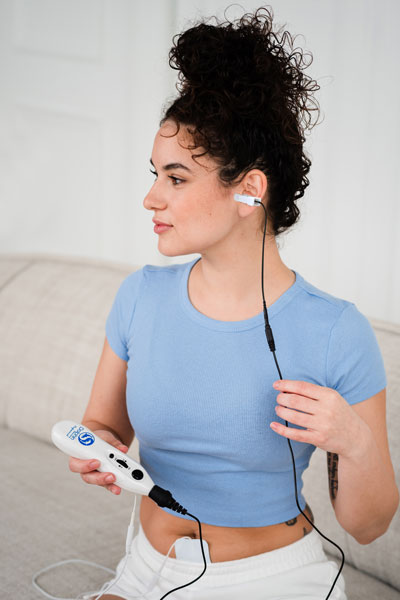
| How it is applied | Sticky pads over or around the sore area | Pads, conductive gloves or damp towels | A hand-held metal tip on acupuncture and trigger points, or ear clips |
| What you feel | Tingling or buzzing | Usually nothing | A brief pulsing or mild prickle at each point |
| Main aim | Dull pain signals while the unit is on | Support tissue recovery with condition-specific settings | Relax muscles, calm the nervous system and release scar tissue |
| Where you get it | At home or in a clinic | In a clinic with an FSM-trained practitioner | In a clinic with a Dolphin-trained practitioner |
| At Orthosports | No | No | Yes |
What is TENS?
TENS stands for transcutaneous electrical nerve stimulation. A TENS unit sends a pulsed current through sticky pads placed on the skin. The current is strong enough to feel as tingling or buzzing, and it is measured in milliamps.
The idea is simple: the tingling keeps the nerves busy, so fewer pain signals get through, and the body may release some of its own pain-relieving chemicals. Relief tends to last while the unit is on and for a short time afterwards. TENS units are inexpensive and easy to use at home, which is why many people try one first. Research results are mixed: some people get useful short-term relief and others notice little.
What is frequency-specific microcurrent (FSM)?
Frequency-specific microcurrent uses a much smaller current, measured in microamps. That is roughly one thousandth of the strength of TENS, so most people feel nothing during treatment.
What sets FSM apart is the use of two channels at once. Each channel is set to a different frequency: practitioners choose one for the condition they are treating, such as inflammation or scarring, and one for the tissue involved, such as nerve or muscle. The current is delivered through pads, conductive gloves or damp towels, and a session can last from 20 minutes to an hour or more.
FSM has an enthusiastic following among practitioners and patients. The published research is still limited and consists mostly of small studies and case reports, so it is best seen as a promising option, not a proven one.
What is MPS (microcurrent point stimulation)?
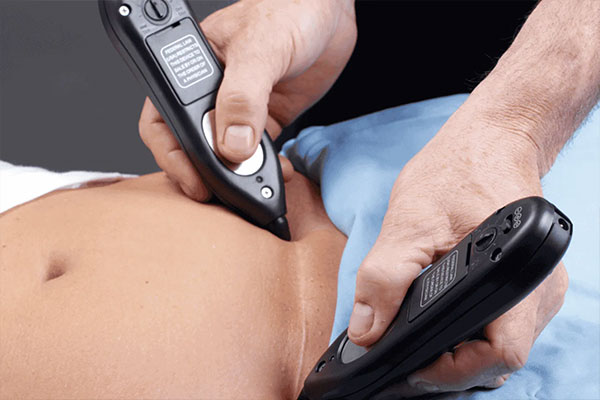
MPS stands for microcurrent point stimulation. It was developed in Canada and is delivered with a hand-held device called the Dolphin Neurostim. Instead of covering an area with pads, the practitioner treats one point at a time.
The device has two modes. In search mode it reads the electrical resistance of the skin and signals with a light and a tone when the tip is over an active acupuncture or trigger point. In treatment mode it delivers a brief dose of low-frequency DC microcurrent to that exact point. A session follows a planned sequence of points chosen for your condition.
At Orthosports, MPS is used for chronic pain, scar release, vagus nerve stimulation and as part of Concussion Recovery Therapy. As with FSM, the research so far comes mainly from small studies, and larger independent trials are still needed. You can read more on our Dolphin MPS therapy page.
Is the Dolphin Neurostim a TENS unit?
On paper, yes: regulators group the Dolphin Neurostim with TENS devices, because it stimulates nerves through the skin. In practice it is used very differently from a home TENS unit. A TENS unit covers an area with a stronger current for 20 to 30 minutes. The Dolphin applies a small, concentrated current to one precise point for a short time, then moves to the next.
If the current is DC, how can it have a frequency?
This is a fair question. Direct current flows in one direction only, while the alternating current in a wall socket changes direction many times a second. The Dolphin delivers direct current in short pulses, about three per second. So the current never reverses, which makes it DC, but it switches on and off at a steady rate, which gives it a frequency. That rate is fixed. FSM, by contrast, is built around choosing from many different frequency pairs.
Which one is right for you?
There is no single best option. It depends on what you are trying to solve.
TENS may suit you if
- You want an inexpensive tool to take the edge off pain at home
- Your pain is fairly simple and you mainly need relief during flare-ups
FSM may suit you if
- You prefer a treatment you cannot feel
- You have access to a practitioner trained in FSM and are comfortable with a newer method
MPS may suit you if
- Your pain keeps returning after massage, physiotherapy or chiropractic
- You have a scar that feels tight or seems connected to your pain
- Stress, poor sleep and muscle tension seem to feed each other
- You like the idea of acupuncture points but do not want needles
Frequency-specific microcurrent in Calgary: what to know
Several Calgary clinics offer frequency-specific microcurrent. Orthosports is not one of them, and we would rather say so plainly than let you book the wrong appointment.
What we do offer is Dolphin MPS therapy. If you were searching for FSM because you want a gentle, drug-free electrical therapy for long-standing pain, scars or a nervous system that will not settle, MPS is aimed at the same kinds of problems with a different method. Orthosports is one of the few Calgary clinics using the Dolphin Neurostim for pain.
Who should avoid electrical stimulation?
TENS, FSM and MPS are generally well tolerated, but none of them is right for everyone. Tell your practitioner before treatment if you:
- Have a pacemaker, implanted defibrillator or any other implanted electrical device
- Are pregnant
- Have epilepsy or a history of seizures
- Have a serious heart rhythm condition
- Are in active cancer treatment
- Have broken or irritated skin over the area to be treated
If you have a medical condition, check with your doctor first.
What an MPS session looks like at Orthosports
Every visit starts with an assessment: a conversation about your pain and history, followed by movement and muscle testing. Sergey then uses the Dolphin to locate and treat the points that match your pattern, and retests your movement so you can feel what has changed. MPS is often combined with NeuroKinetic Therapy (NKT) or manual osteopathy in the same visit. There is no downtime afterwards.
Frequently asked questions
Is MPS the same as frequency-specific microcurrent?
No. Frequency-specific microcurrent (FSM) runs two channels of very low current at paired frequencies through pads, gloves or damp towels. MPS applies low-frequency DC microcurrent to individual acupuncture and trigger points with a hand-held Dolphin Neurostim device.
Is the Dolphin Neurostim a TENS unit?
Regulators group it with TENS devices, because it stimulates nerves through the skin. In practice it is used very differently from a home TENS unit: it applies low-frequency DC microcurrent to precise points for a short time each, instead of sending a stronger current through sticky pads.
Which is better for chronic pain: MPS, FSM or TENS?
There is no single best option. TENS is an inexpensive way to dull pain at home. FSM and MPS are clinic treatments that aim to change how the tissue and nervous system behave. The right choice depends on your condition, your health history and how you respond.
Does microcurrent therapy hurt?
FSM is usually not felt at all. MPS produces a brief pulsing or mild prickle at each point that fades within seconds. TENS feels like tingling or buzzing under the pads.
Where can I get frequency-specific microcurrent in Calgary?
Several Calgary clinics offer frequency-specific microcurrent. Orthosports Calgary does not. We offer Dolphin MPS therapy, a point-based microcurrent treatment, at 205-222 58 Ave SW, across from CF Chinook Centre.
Is microcurrent therapy covered by insurance in Alberta?
It depends on who provides it and on your plan. At Orthosports, MPS is provided within a massage therapy appointment with a registered massage therapist, and we direct bill Sun Life, Canada Life, Alberta Blue Cross, Medavie Blue Cross and Green Shield.
Still in pain after trying everything else? Book an MPS session with Sergey Raiter at Orthosports Calgary and find out in person whether it helps.
Book your appointment at Orthosports Calgary or call 403-984-9962.
This article is for general information and is not medical advice.